
_________________________________________________________________________________________________
Demonstration Project Competition
_________________________________________________________________________________________________
Scientific poster competition
2 – Design and Implementation of a Highly Reconfigurable High-Voltage Driver IC for Electrostatic MEMS Switch Arrays
Reyhaneh Taherpour Kalantari, ÉTS
Array-based electrostatic micro electromechanical systems (MEMS) switches require compact interfaces that can generate programmable actuation voltages, distribute them across multiple electrodes, mitigate reliability degradation, and verify switching states electrically. This paper presents a fully integrated driver and multiplexer integrated circuit (IC) that addresses these requirements through a programmable Dickson charge pump, two shared high-voltage multiplexers (HVMUXs), eight bidirectional output channels, floating level shifters, digital decoding logic, and a pull-in state-detection circuit. The two HVMUXs independently route selected charge-pump taps to the upper and lower terminals of the switch array. By reconfiguring these paths, the IC enables polarity reversal across the actuator without requiring a negative supply. This bipolar actuation scheme reduces prolonged fixed-polarity biasing, thereby addressing dielectric-charging and stiction-related reliability concerns, while sharing the voltage-generation and routing circuitry across multiple array channels. The prototype was manufactured in a 180-nm high-voltage BCD technology and occupies 2.0 mm × 1.6 mm, including pads and seal ring. Measurement results show a charge-pump output voltage of 34.4 V and a driver output voltage of 34.1 V. With a 4 pF capacitive load, the driver achieves worst-case rise and fall times of 2.039 μs and 1.736 μs, respectively. The integrated current-sensing technique is experimentally verified under bipolar actuation, demonstrating electrical state detection for reliable switch-array operation. Overall, the proposed IC provides a compact, reconfigurable, and testable interface for scalable electrostatic MEMS actuation.
3 – Strengthening mine safety through reconfigurable smart surfaces
André-Louis Morneau, École de technologie supérieure
The mining industry is a major economic driver for Quebec and Canada, but it remains a hazardous environment where the lack of direct line of sight in the complex environments of underground mines compromises wireless communications, a key element for improving worker safety. To overcome these limitations, our project aims to develop a stretchable metasurface for integration into a reconfigurable smart surface for 6G communications, thereby improving wireless communication in underground environments. To achieve this, we fabricated a metasurface on a stretchable substrate using flat screen printing to obtain an adjustable response through simple mechanical deformation—a simple and inexpensive approach enabling large-scale production. The effect of this deformation on system performance was then characterized by terahertz spectroscopy, and the results will be used to train a neural network designed to automatically optimize the response based on the stretch. Ultimately, this approach could improve radio coverage in mining environments by reducing dead zones, thus paving the way for the development of identification beacons facilitating real-time location and accident prevention.
4 – Additive manufacturing of PEDOT:PSS\/graphene oxide sensors for in-ear core body temperature monitoring
Ankur Gohel, Higher School of Technology
This research work demonstrates a fully integrated 3D printed electronics platform for wearable temperature sensing based on a PEDOT:PSS/graphene oxide (GO) composite materials. The sensor, fabricated via micro-dispensing technology (MDT) on flexible substrates, exhibits high uniformity with consistent baseline resistance across devices. The electrical characterization reveals a stable and repeatable negative temperature coefficient (NTC) response within the physiologically relevant range of 25 to 45 °C, with a sensitivity of 1.68 % °C⁻¹ and excellent linearity (R² = 0.998). The device shows rapid response ~9 sec and recovery ~22 sec, along with minimal hysteresis and strong cyclic stability over repeated thermal loading. Encapsulation with Parylene C significantly enhances environmental robustness, enabling stable operation under varying humidity and exposure to aqueous environments. The ultrathin sensing layer further contributes to fast thermal equilibration and reliable performance. For biomedical application, the sensor is integrated onto a customizable 3D silicone earplug, enabling conformal contact within the ear canal for accurate core body temperature monitoring. The biocompatible and flexible design ensures long-term wearability without discomfort, even during daily activities such as walking, running, and cycling. Overall, this research highlights the potential of 3D printed electronics for personalized, customizable, and high-performance temperature sensors in next-generation wearable biomedical systems.
5 – First-Ever Integration of Ionic Liquid Crystal Elastomers (iLCEs) into Soft MEMS Transducers for Multifunctional Electro-Skin Applications
Elaheh Asgari, Higher School of Technology
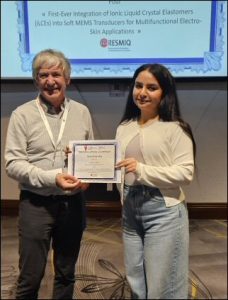
The advancement of microelectromechanical systems (MEMS) toward flexible and multifunctional architectures is hindered by the rigidity of traditional materials such as silicon and ceramics. This limitation restricts the development of next-generation devices capable of adaptive deformation, low-voltage operation, and multifunctional performance essential for wearable electronics, soft robotics, and biomedical applications. To overcome these challenges, this research introduces the first-ever integration of ionic liquid crystal elastomers (iLCEs) into soft MEMS transducers. iLCEs combine the molecular order of liquid crystals with the elasticity of polymers and the ionic conductivity of liquid electrolytes, enabling reversible, programmable actuation and sensing under low electrical stimuli (~1 V). The study is structured into three main objectives: (1) the development of an aligned LCE as a reference system for iLCE synthesis, (2) the fabrication and integration of iLCEs into MEMS microcantilevers, and (3) the realization of a multifunctional iLCE-based MEMS electro-skin capable of selective actuation, sensing, and energy harvesting. The iLCEs developed in this work exhibit substantial strain (>50%), rapid response, and high flexo-ionic sensitivity (~220 μC/m), making them ideal candidates for soft microsystems that operate efficiently under small or low-frequency mechanical inputs. This research establishes a foundation for a new class of soft, intelligent MEMS that can dynamically interact with their environment while maintaining mechanical flexibility, electrical responsiveness, and scalability. The resulting iLCE-based electro-skin pave the way for next-generation biomedical interfaces, adaptive wearable sensors, and shape-morphing electronics, representing a significant step toward fully integrated multifunctional microsystems.
6 – The fifth dynamic factor: skin temperature and its impact on gesture recognition by EMG
Étienne Michaud, Laval University
Surface electromyography (sEMG) has become a cornerstone of gesture recognition in the control of prostheses and human-machine interfaces. However, its performance is often affected by several dynamic factors, including gesture intensity, limb position, electrode displacement, and signal non-stationarity. This work introduces and investigates skin temperature as a "fifth" dynamic factor influencing sEMG-based gesture recognition. Synchronized sEMG, photoplethysmography (PPG), and inertial measurement unit (IMU) data were recorded from 12 limb-neutral participants performing five hand/wrist gestures under three temperature conditions (cold, reference, and warm) using the BioPoint wearable device. The analysis revealed that cold conditions increased the mean absolute value and reduced the median frequency of sEMG signals, while signal complexity (assessed via fuzzy entropy) remained largely unchanged. Gesture recognition models trained solely on reference data showed decreased accuracy when tested under non-nominal temperature conditions. Conversely, training that included data covering a range of temperatures improved classification robustness across thermal conditions, at the cost of a slight performance degradation under reference conditions. Furthermore, while a multi-sensor approach combining EMG, PPG, and IMU improved accuracy under reference conditions, it also exhibited increased sensitivity to temperature variations. These results highlight the need to develop strategies that account for skin temperature when designing robust sEMG-based gesture recognition systems. Finally, we present a new dataset of hand gestures collected under different skin temperature conditions to support future work aimed at developing more adaptive and reliable gesture recognition solutions.
7 – F-shape-based Scheme for Detection of Multiple Sclerosis using Optical Coherence Tomography Images
Homa Tahvilian, Concordia University
Background: Multiple sclerosis (MS) is an inflammatory demyelinating autoimmune disorder affecting the central nervous system (CNS). The consequences of demyelination and subsequent axonal loss are manifested in the thinning of the retina layers. Optical coherence tomography (OCT) is an inexpensive, non-invasive tissue imaging technique that provides cross-sectional images of the retina using infrared light for tissue penetration. Objective: The objective of this paper is to develop an F-shape-based scheme for the binary classification of MS disease using the thickness of ganglion cell-inner plexiform layer (GCIPL) layers in the macula region of the OCT images. Method: The OCT images of 37 healthy and 35 MS subjects from the macula region were obtained. Subsequently, F-shape objects were formed for each subject by using the inner limiting membrane (ILM) surface as geometry and GCIPL thickness as a function in a selected region of interest (ROI). F-shape objects are registered on a common template using atlas registration. The residual F-shapes, defined as the difference between the F-shape of this common template and the individual registered F-shapes, are used to train a support vector machine (SVM) classifier and subsequently to detect MS. The performance of the proposed method is compared with the corresponding SVM classifier developed based on the features obtained using the early treatment diabetic retinopathy Study (ETDRS) grid. Results: The proposed F-shape-based scheme is shown to significantly outperform the sectoral-based schemes. In particular, the F-shape-based SVM classifier developed in this study identified MS cases with a sensitivity of 89%, specificity of 100%, accuracy of 95%, and an area under the curve (AUC) of 99 %. Conclusion: The superior performance of the proposed F-shape-based scheme can be attributed to the use of (i) a highly dense mesh formed on the ROI in the macula region, (ii) atlas registration that puts the F-shapes of all the subjects on a common platform, and (iii) residual thicknesses as input features for the classification.
8 – Quasi pin Organic Photodetectors for Self-Powered Dual-Wavelength Sensing
Hossein Anabestani, McGill University
We report a quasi p–i–n organic photodetector (OPD) enabled by p-type (P3HT:BCF) and n-type (ZY-4Cl:N-DMBI) doped layers flanking a P3HT:ZY-4Cl bulk heterojunction. Mott–Schottky analysis revealed effective carrier concentration with doping, achieving ~2.9×10¹⁷ cm⁻³ for holes and ~1.7×10¹⁷ cm⁻³ for electrons. Thin doped layers (10 nm p-type, 20 nm n-type) maintained >90% optical transmission. Compared to conventional BHJ OPDs, the quasi p–i–n design reduced dark current by a factor of 10 and enhanced photocurrent by ~3× under green and ~4.3× under red illumination. Depletion calculations confirmed extended electric fields into the intrinsic layer, enabling efficient charge extraction and reliable self-powered operation.
10 – 3D printed electrode array for gesture recognition and control of smart prostheses
Jonathan Levesque, Laval University
Myoelectric prostheses enable the control of artificial devices using electrical signals produced by muscles. However, the reliability of these systems depends heavily on the quality of the electrodes used to capture electromyographic (EMG) signals. In this project, we developed a 3D-printed EMG electrode array designed to improve gesture recognition and facilitate the control of myoelectric prostheses. The device is based on a flexible, thermoplastic-printed structure that conforms to the shape of the forearm, into which conductive electrodes made of graphite-doped polymer are integrated. This additive manufacturing approach allows for the production of customizable, lightweight, and low-cost sensors. The system comprises 18 electrodes (12 signal and 6 reference) enabling the simultaneous acquisition of EMG signals. Tested with ten participants performing six hand gestures, the device achieved an average recognition accuracy greater than 90 %. These results demonstrate the potential of 3D printing to develop more accessible and efficient muscle interfaces for assistive technologies.
13 – TFA Net: A Temporal Frequency Adversarial Network for Robust ECG Based Emotion Recognition in Dynamic Driving Environment
Nastaran Mansourian, Concordia University
Emotion recognition from physiological signals plays a critical role in advancing human–machine interaction, particularly in intelligent transportation systems and affective computing. However, deep learning models often suffer from poor cross-subject generalization, limiting their practical deployment. To address this challenge, we propose a Temporal–Frequency Adversarial Network (TFA-Net), a few-shot calibration framework designed to mitigate subject dependency in ECG-based emotion recognition. The proposed framework integrates contextual representations extracted from a pretrained Electrocardiogram Foundation Model (ECG-FM) with spectral features derived from short-time Fourier transform (STFT) to capture complementary temporal and frequency characteristics. These multi-view representations are fused using a Nested Mixture of Experts (NMoE) module and refined through a learnable Fractional Fourier Transform (FrFT)-based attention mechanism, which dynamically emphasizes discriminative temporal–frequency patterns. To further improve subject-invariant representations, a Dual-Phase Adversarial Learning (DPAL) strategy is introduced to direangle emotion-relevant features from subject-specific information using gradient reversal. Experiments conducted on the manD 1.0 driving dataset, as well as two benchmark datasets (DREAMER and WESAD), demonstrate that the proposed approach consistently outperforms existing methods under few-shot cross-subject evaluation protocols. These results highlight the potential of TFA-Net for robust emotion recognition in intelligent transportation and mental health monitoring applications.
15 – A Linear Ultra-Low Flicker Noise Switched-Transconductance Downconversion Mixer
Saeed Ghaneei Aarani, Laval University
This work presents a current-mode double-balanced switched-transconductance (SwGm) downconversion mixer designed to mitigate partially upconverted flicker noise and second-order intermodulation (IM2) in conventional SwGm architectures. The proposed approach employs drain–source swapping of the transconductance stage at each half cycle of the local oscillator, resulting in a symmetric transconductance profile with zero average value. This operation, enabled by series capacitors, ensures full upconversion of low-frequency noise components. Compared to prior works, the proposed technique achieves a significantly reduced flicker-noise corner and improved thermal-noise performance, while relaxing voltage headroom limitations associated with resistive loads. A prototype implemented in 65-nm CMOS operates at 6 GHz with a 100 MHz IF bandwidth. Measurement results show 11.8 dB conversion gain and 7 dB noise figure (10 kHz–100 MHz), with a 1 kHz flicker corner and 3 mW power consumption from a 1 V supply. Compared to conventional SwGm mixers with approximately 11.2 dB noise figure, the proposed design achieves a 4.2 dB noise figure reduction, while simulations indicate a flicker-noise corner around 5 MHz for conventional designs, corresponding to more than 1000× improvement in flicker-noise performance. The design also achieves IIP2\/IIP3 of 75 dBm\/0.9 dBm within a compact area of 0.396 mm².
17 – Comprehensive GPS Attack Defense in UAV Networks: From Zero-Day Detection and Classification to Autonomous Mitigation
Seyyedeh Maryam Mazloom, Concordia University
Unmanned aerial vehicles (UAVs) rely heavily on GPS for navigation and mission execution, making them vulnerable to spoofing and jamming attacks that can compromise safety and mission objectives. Our work presents two complementary meta-learning (ML) frameworks spanning the full defense pipeline: zero-day attack detection-classification and autonomous attack mitigation in UAV networks.\r\nThe first framework integrates statistical extreme value ML with a dual-path classifier to detect and classify GPS attacks, overcoming excessive training data needs, zero-day vulnerability, and disjointed detection\/classification. Few-shot prototype-based anomaly detection combined with a prototypical OpenMax layer identifies suspicious GPS telemetry, while a dual-path model classifies attacks as spoofing or jamming. The framework achieves 97.33% detection accuracy and 0% false alarm rate, outperforming existing methods. To enable autonomous recovery under active attacks, we propose MRDM-UAV, a meta-reinforcement learning framework for simultaneous detection and mitigation of multiple GPS attack types. By combining model-agnostic ML with deep Q-networks, where the system learns a generalizable defense policy using fused navigation and signal-quality features. MRDM-UAV achieves 99.1% detection accuracy and 97.6% mission success rate, outperforming state-of-the-art baselines.
18 – Inpaint Once, Warp Many: Gaussian Splatting and Panoramic Diffusion for 360° Video
Sharifi Pooya, Concordia University
Generating temporally consistent 360° video from partial perspective observations is fundamentally limited by the stochastic nature of generative models. Applying per-frame diffusion to hallucinate missing regions introduces severe high-frequency temporal noise, resulting in unacceptable background flickering (or «boiling»). We propose a novel 3D-grounded pipeline that formulates this as a signal stability problem. First, we maximize the structurally accurate, real signal using 3D Gaussian Splatting (3DGS), increasing spatial coverage from 15% to 63% while preserving complex, view-dependent high-frequency details like reflections. To reconstruct the unobserved regions without introducing temporal discontinuities, we perform a single-pass stochastic generation on a reference frame using DiT360. This background signal is then mathematically propagated across the sequence via equirectangular rotation warping with Lanczos interpolation to prevent spatial aliasing. Disocclusions caused by parallax are tracked via a propagated validity mask and resolved using deterministic spatial interpolation (PDE-based filling). By explicitly preventing the re-injection of stochastic noise at frame boundaries, this method drastically reduces temporal variance. Our approach yields a 33% reduction in spatial L1 error, reduces temporal L1 error by 27%, increases cross-frame SSIM by 61%, and reduces computational overhead by 20× compared to per-frame generative baselines.
19 – SGDC: Structurally-Guided Dynamic Convolution for Medical Image Segmentation
Bo Shi, Concordia University
Spatially variant dynamic convolution provides a principled approach of integrating spatial adaptivity into deep neural networks. However, mainstream designs in medical segmentation commonly generate dynamic kernels through average pooling, which implicitly collapses high-frequency spatial details into a coarse, spatially-compressed representation, leading to over-smoothed predictions that degrade the fidelity of fine-grained clinical structures. To address this limitation, we propose a novel Structure-Guided Dynamic Convolution (SGDC) mechanism, which leverages an explicitly supervised structure-extraction branch to guide the generation of dynamic kernels and gating signals for structure-aware feature modulation. Specifically, the high-fidelity boundary information from this auxiliary branch is fused with semantic features to enable spatially-precise feature modulation. By replacing context aggregation with pixel-wise structural guidance, the proposed design effectively prevents the information loss introduced by average pooling. Experimental results show that SGDC achieves state-of-the-art performance on ISIC 2016, PH2, ISIC 2018, and CoNIC datasets, delivering superior boundary fidelity by reducing the Hausdorff Distance (HD95) by 2.05, and providing consistent IoU gains of 0.99%-1.49% over pooling-based baselines. Moreover, the mechanism exhibits strong potential for extension to other fine-grained, structure-sensitive vision tasks, such as small-object detection, offering a principled solution for preserving structural integrity in medical image analysis. To facilitate reproducibility and encourage further research, the implementation code for both our SGE and SGDC modules has been publicly released at https://github.com/solstice0621/SGDC.
20 – CND-TTT: A Color Noise Denoising Approach for 3D Test-Time Training
Ghofrani Majelan Sina, Concordia University
Deep learning models for 3D point cloud classification perform well on clean data but often struggle with real-world corruptions like sensor noise, environmental interference, and geometric distortions. To address this challenge, we propose CND-TTT, a novel Test-Time Training (TTT) framework that enhances robustness by introducing a structured, frequency-aware self-supervised objective. Unlike conventional noise models, CND-TTT leverages color noise, which is characterized by specific power spectral properties, to simulate realistic and controllable disturbances across frequency bands. During pre-training, the model learns to denoise frequency-specific corruptions injected into grouped point subsets, capturing both local geometric structure and global contextual information. At test time, this denoising objective enables unsupervised adaptation to out of distribution (OOD) inputs without requiring labels or retraining. To our knowledge, this is the first work to leverage frequency-domain disturbances as an auxiliary learning signal in point cloud TTT. Experimental results show that CND-TTT consistently outperforms state-of-the-art (SOTA) TTT methods across multiple datasets and corruption scenarios, while maintaining competitive adaptation speed. Our approach offers a scalable and effective solution for deploying 3D models in dynamic and noisy real-world environments.
22 – Leveraging Large language Models for Coverage Driven Verification of Open Source RISC-V Cores
Zoya Ahmed, Concordia University
The verification of open-source processors, such as RISC-V cores, remains challenging due to the increasing complexity, heterogeneity, and stringent quality requirements of modern hardware systems. In this research, we present VeriLLM, an industry-aligned LLM-assisted verification framework for RISC-V processors that generates fully functional assembly programs as test stimuli, simplifying post-simulation debugging and result processing. VeriLLM introduces three key contributions: (1) it distinguishes hint-before-solving prompting for self-checking, deterministic test generation from iterative, zero shot prompting for coverage-driven, constrained-random test generation; (2) it generates RISC-V ISA-compliant, self-checking deterministic tests and coverage-driven constrained-random tests for architectural and microarchitectural verification; and (3) it implements a coverage-guided iterative prompt refinement loop for constrained-random tests, accelerating coverage closure. The framework leverages LLMs not merely for natural language tasks, but as reasoning engines for automated, adaptive stimulus generation aligned with industrial verification workflows. Evaluation on the production-quality 32-bit Ibex RISC-V core demonstrates that VeriLLM accelerates coverage closure and improves verification efficiency, achieving a functional coverage gain of 32.68% over conventional constrained-random testing and 48.97% over the state-of-the-art LLM-assisted framework LLM4DV, while maintaining a modular design easily adaptable to other open-source processor cores.
23 – Microwave-Induced Fluorescence of Ensemble NV Centers Using PCB-Based RF Devices for Quantum Sensing
Atefe Safinezhad, ETS
Nitrogen-vacancy (NV) centers in diamond are solid-state quantum sensors that operate at room temperature and allow optical readout of spin states through optically detected magnetic resonance (ODMR). Reliable ODMR measurements need controlled microwave excitation to manipulate NV spin states and modulate their fluorescence. In this work, we study how ensemble NV centers interact with microwave fields transferred by printed circuit-board (PCB) radio-frequency devices. Two microwave structures, a coplanar waveguide transmission line (CPW-TL) and a single-finger interdigitated capacitor (IDC), are designed and impedance-matched at the NV zero-field splitting frequency. Nanodiamond solutions containing NV ensembles are deposited as few-microliter droplets onto the PCB devices and dried, forming localized NV layers on the RF structures. Two-dimensional fluorescence scans are used to link spatial changes in NV fluorescence to the microwave field distributions created by each device geometry. The results show that microwave-induced fluorescence depends strongly on position. CPW-TLs enable interaction over extended regions along the transmission line, while IDCs produce strong but localized excitation near the capacitive gaps. The results demonstrate that PCB-based microwave devices offer a scalable and flexible platform for controlled NV excitation, supporting spatially engineered microwave–NV interactions toward integrated quantum sensing systems.
Demonstration Project Competition
1 – Development & Advancement of Scalable, Wearable, Self-Powered Ultrasonic Transducers Integrating Flexible Piezoelectric Materials via Printed Electronics For Biomedical Applications
Rubab Fatima Naqvi, Higher School of Technology
The need for continuous, real time monitoring technologies has increased due to the rising prevalence and mortality of chronic diseases. Early intervention for such ailments proves to be beneficial which gives the rise to wearable healthcare devices functioning on self-generated power for seamless monitoring. Ultrasonic technology is widely studied and employed in the healthcare sector due to its fast response and integration with other technologies. The overarching objective of this research is to develop a fully power autonomous, scalable for mass production, wearable ultrasonic transducing device with biomedical applications such as diagnostics, continuous monitoring and therapeutics of various physiological parameters. To help understand the objective better and to divide them into more attainable goals, below are the specific objectives:
1.To design and manufacture an energy harvesting layer integrating PVDF and Ecoflex for flexibility and maximum power generation.
2.To design a flexible, printed supercapacitor layer using dry carbon films for charge storage and fluctuation-free power source.
3.To design and manufacture an optimized hybrid PVDF/PZT piezoelectric ultrasonic layer for flexibility and sensitivity
To deploy flexography as a printing technique for compatible layers for scalable manufacturing and mass production
3 – Impedance-triggered holographic imaging cytometer
Karim Bouzid, Laval University
We offer an in-situ holographic imaging cytometer triggered by an electrical impedance measurement. This device automatically characterizes aquatic microparticles from 5 to 200 µm, providing information such as size, morphology, composition, and volume. It delivers near real-time results directly in the natural environment, without requiring human intervention during the measurement phase. Portable, it can be easily moved from one measurement point to another. This system thus automates environmental monitoring of microplastics, whose presence in waterways is constantly increasing. It also allows for the identification of certain types of algae and plankton based on the measured characteristics and alerts the user in the event of the detection of potentially dangerous species. It therefore offers a rapid diagnostic tool for applications such as swimming, while ensuring continuous monitoring of the presence and concentration of different species. The system consists of an impedance measurement PCB, a holographic system, a microfluidic cartridge, a camera, lasers + controllers, a power supply PCB, a micropump + controller, and a Raspberry Pi 5 microprocessor. It is therefore very clearly a complex microsystem worthy of ReSMiQ.
4 – High-density electromyography (HD-EMG) sensor for myoelectric control applications such as smart prostheses
Félix Chamberland, Laval University

This project presents EMaGer, a wireless HD-EMG (High-Density Electromyography) sensor designed to record forearm muscle activity with high resolution. The device uses a grid of 64 electrodes placed on the skin to capture the electrical signals produced by the muscles when the user attempts a hand movement. This data is transmitted in real time via Wi-Fi to a laptop at a sampling rate of 2000 Hz, enabling the capture of rapid variations in muscle signals. The sensor can also be configured via a mobile application using Bluetooth Low Energy (BLE). One of the innovative aspects of this project is the use of a dense electrode grid, allowing for the capture of significantly more information than traditional myoelectric systems, which typically use only a few sensors. Furthermore, unlike most existing HD-EMG systems, which are often laboratory setups connected to bulky acquisition equipment, EMaGer is designed as a fully wireless wearable device. It is one of the first wearable HD-EMG systems and the first designed as a wristband, making the technology much easier to use in real-world settings. The proposed demonstration will take place in two stages. First, participants will be able to observe the EMG signals in real time, both temporally and spatially, to visualize how muscle activity changes when different gestures are performed. Second, these signals will be used to perform real-time gesture classification. When a user makes a gesture with their forearm, the system detects the corresponding muscle activity and sends a command to a robotic hand connected to the computer, which then replicates the detected gesture. The setup presented will include the HD-EMG EMaGer sensor, a laptop computer for receiving and analyzing the signals, and a robotic hand to demonstrate how muscle signals can be used to control a mechanical device. This type of technology can contribute to the development of more intuitive prosthetic hands for amputees, while also having applications in biosignal research, human-machine interfaces, and biomedical technology education.
ReSMiQ Annual Conference
JIR2026 and 15th Microsystems Technical Demonstration Competition